
Deep Dive: My Seven-Figure Alternative Investment Portfolio (2026 Update)
Updated: Jun 2
By Ian Ippolito · Last updated May 26, 2026 · Code of Ethics
Several previous years had unusually strong, across-the-board performance. This year my alternative portfolio behaved more typically, with a mix of cycles across it's diversified holdings. The up-cycle and uncorrelated strategies performed well. And despite real-estate being in a down-cycle (and many aggressive deals imploding) income was good --- and illustrated the strengths of vintage year investing and sticking with conservatively structured deals. Here's an in-depth look at my portfolio strategy, allocations, deal-by-deal performance, tax considerations, future strategy, and more.

(Usual disclaimer: I'm just an investor expressing my personal opinion and am not an attorney, accountant nor your financial advisor. Consult your own financial professionals before making any financial decisions. Code of Ethics: To remove conflicts of interest that are rife on other sites, I/we do not accept ANY money from outside sponsors or platforms for ANYTHING. This includes but is not limited to: no money for postings, nor reviews, nor advertising, nor affiliate leads etc. Nor do I/we negotiate special terms for ourselves in the club above what we negotiate for the benefit of members. Info may contains errors so use at your own risk. See Code of Ethics for more info.) Many people ask me, "What's in your alternative investing portfolio and how's it doing?" So since 2017 I've shared detailed break-downs about what I'm invested in, how it's doing, and my detailed thoughts on each one. And this is deep-dive #8.
Important note (March 7, 2026): Year-end valuations are not yet available for most private placements. And these typically arrive in late spring or summer due to the extensive year-end work required for audits and reporting. So normally I would wait for those before publishing this update. But many readers have been asking to see many of the other portions of this deep-dive and are also interested in my thoughts on how AI may affect future investments. So for now, I’ve marked those valuations as TBD (to be determined) and also marked portfolio-level returns the same way. Returns derived solely from income or realized exits are not affected by valuations and are shown below.
In some previous portfolio updates, I was surprised by exceptional performance across the board. And often all my alternatives significantly outperformed my stock market and other investments.
As I noted each time, that kind of across-the-board strength is rare, and I don’t expect it to happen every year. And this year, my alternative portfolio behaved more typically.
I purposefully have diversified it across several asset classes that generally have their own cycles (GP stakes, litigation finance, music royalties, real estate, search funds, private equity etc.). The idea is that these asset classes move in and out of favor at different times. And this allows different investments to carry the load.
Here's an overview of how that played-out over the last year:
Returns from income alone (i.e. not yet counting price appreciation in the last year, which is still TBD) was about 6.33%.
Up-cycle / uncorrelated to cycles / moderately-challenging cycle:
This includes GP stakes, litigation finance, music royalties, search funds, private equity, no-debt residential rentals etc.
And these are generally performing in line with expectations or better. YTD returns from income/exit sales ranging from 2.92% - 26.98% (and not yet counting price appreciation in the last year, which is still TBD).
Recovering from a down-turn:
Certain types of commercial real-estate (multifamily and office) are recovering from a downturn a few years ago (2022) -- after previously enjoying a typically decades-long upcycle (2010-2020):

And during the drop and recovery (2022-2025) many aggressive deals have imploded and their investors have taken catastrophic realized losses (often -100%).
On the other hand, my investments have done exactly what I'd hoped they'd do -- avoiding disastrous defaults and painful distressed sales -- so that interim valuations can increase as the cycle fully recovers.
And in the meantime, they’re also generally producing very nice income and substantial tax deductions and also demonstrating the strengths of vintage-year investing and conservatively structured deals.
The income return on multifamily was 4.51% tax-deferred, which equates to 7.16% equivalent taxable-return (using our marginal federal tax rate of 37%). And if we lived in a different state (with state income tax) the equivalent tax-able return would have been even higher.
None of this happened by accident.
It took a lot of discipline during that long, two-decade up-cycle to deliberately pass on many aggressive high-projected-return deals ... and focus instead on boring, conservative ones with higher down-cycle safety.
And it also took a lot of consistent effort and patience to build a vintage-year portfolio.
This article will share all of the low-level details (as well as my personal context and strategy). Here are the sections:
About me (so you can put my portfolio choices into perspective)
Current portfolio overview and strategy (and changes from last time)
Benchmark comparison with other alternatives (stocks, bonds, real estate indices as well as the performance of my last update)
Portfolio allocation
Investment-by-investment deep-dives
My strategy for the future
Plus bonus features:
7) How I manage cash
8) Investment-by-investment deep-dives on taxes
So let's start off with a little bit about me and my personal situation, so you can understand my portfolio choices.
About me
First, every person has a unique financial situation, set of financial goals, and risk tolerance. And something that looks great to one investor will look horrible to another (and vice versa). So there's no such thing as a single sponsor, investment or strategy that's right for everyone. And many people will disagree with my own choices. And that's okay and expected because everyone's different.
I'm a retired serial tech-entrepreneur and my investments help support myself and my family. And my risk tolerance for loss is very low, compared to many others.
So I’m generally uninterested in aggressive deals that project high, "exciting" returns (even when most investors flock to them). And that's because higher yield generally comes with higher risk -- and the math on large losses is surprisingly unforgiving.
An investor who loses 90% on an investment needs to earn a whopping 900% on future investments just to break even. So even if they later earn an improbably huge 29% per year for the next 9 years -- they would still only be back to square one.
So realistically, a single large loss can easily wipe out all the gains of the next upcycle (and more).
And unfortunately, I see many investors doing something like this:

My goal, is to try to do this, instead:

So I deliberately target conservative deals that minimize the chance of large losses. And I prefer un-flashy, boring sponsors with full-cycle experience little to no money lost, lots of skin in the game, conservative leverage and reasonable waterfalls.
And so far, I've been pleased that I've managed to pull this off (as I'll describe below).
For more details on the above see “The Devastating Mistake in Real Estate Investing that Happens All the Time – and How to Avoid It“
My Portfolio Overview
My wife and I share financial decisions and have a broad portfolio. And this includes seven figures invested in "alternative investments."
These fall outside the traditional box of public equities, bonds, and cash investments, which the typical investor recognizes and usually gets through a broker or online platform for retail investors. Many alternatives are only available to higher net-worth investors and/or institutions. And they're typically only found through word-of-mouth, crowdfunding, and/or through an investment club.
Here's more info on the design:
Core-satellite design: My alternative investment portfolio follows the core-satellite approach to portfolio design to manage risk. This means that the majority of it is placed in a huge, conservative core. And that lets me feel comfortable taking more risk on smaller satellite portions. I'll talk about this more in the detailed sections below.
Asset-class selection: The portfolio is mostly invested in real estate with additional investments in a variety of hard-to-find asset classes that are not directly tied to the business cycle (like GP stakes, litigation finance, search fund sponsors and music royalties). More details on this are also below.
Vintage-year strategy: I don't try to time real estate (and other) markets, because I believe it can't be done profitably over the longer-term. And had I tried doing that, I would have missed out on many years of great returns in the past. Instead, I use a "vintage year" strategy (which is similar to dollar cost averaging in the stock market). Instead of deploying my entire portfolio in a single year, I deploy a portion of it every year. And this way, no single bad vintage year can take out the whole thing. Also, in the past, once-in-a-cycle high returns have happened right after some of the worst vintage years. But it can be very psychologically difficult to pull the trigger and invest at those times. So a vintage year strategy keeps me in the game, so I can participate when this happens (similar to dollar cost averaging).
"Money bucket" design:
Every portfolio is essentially just a single bucket of savings. But that one bucket actually needs to serve several different purposes. And ignoring this can accidentally destroy or unnecessarily reduce returns.
For example, many people have been struck out of the blue with the unexpected loss of income (losing a job, investment income, or both). Others are hit with sudden financial emergencies. Without planning for these possibilities, people can be forced to liquidate investments at exactly the wrong time — which can damage or even end the portfolio and the lifestyle it was meant to support.
At the same time, as an investor, I want to maximize returns. And one of the few ways investors can potentially earn an additional return in today’s highly efficient markets is through the illiquidity premium.
This occurs when an investment pays a higher expected return because the investor agrees to lock up their capital for a period of time, rather than having the ability to sell at any moment like in public markets.
Of course, not every illiquid investment offers enough of a premium to make it worthwhile. But when the premium is attractive, I like being able to take advantage of it — as long as I can do so without sacrificing the liquidity needed for emergencies.
To manage this balance, I use a “money bucket” structure. It divides my portfolio into four categories based on when the capital may realistically be needed: cash reserves, short-term, medium-term, and long-term.
Reserves hold several years of living expenses in cash (or close-to-cash equivalents...see later section). This helps me weather unexpected events and prevents them from becoming catastrophic. And it also allows me to take on illiquidity in other portions of my portfolio ( and maximize my overall return). Note: some feel holding years of reserves is excessive and only do months. And every person comes from a different situation and place, so there's no one "right" or "wrong" answer.
The short-term bucket is for public market investments (which can be liquidated close to immediately) and certain private investments with very short timeframes. And I see that many investors will treat this as a "cash reserve" bucket. But I feel there's an important distinction here. If I had an actual cash emergency caused by a severe recession, then I would have to take a severe hit for liquidating public investments. And I probably couldn't liquidate the private ones at all (because they withdrawals would probably be gated). And that could cause big problems. So that's why I feel these can't replace true reserves. But I still like having another level of protection that could work in other circumstances. And again this allows me to take on more illiquidity in other portions of my portfolio.
The medium-term bucket is for investments around 5 years and long-term is for 7 to 10 years plus. Also I stagger the timing of my investments in each bucket. So even in the long-term illiquid ones, the investments are actually maturing and producing cash. And when that happens, I can then either use the money as cash for expenses, replenish reserves, or deploy it into the next investment bucket (which makes the most sense at that time).
Returns
Important note (March 7, 2026): Year-end valuations are not yet available for most private placements. And these typically arrive in late spring or summer due to the extensive year-end work required for audits and reporting. So normally I would wait for those before publishing this update. But many readers have been asking to see many of the other portions of this deep-dive and are also interested in my thoughts on how AI may affect future investments. So for now, I’ve marked those valuations as TBD (to be determined) and also marked portfolio-level returns the same way. Returns derived solely from income or realized exits are not affected by valuations and are shown below.
The portfolio returned about TBD% (for the trailing 12 months). The portion of the return solely for income (and exits) was about 6.33% (with valuation return still TBD).
Before diving into the details, here's how other bench-mark investments did over the past year:
Other benchmarks: Stocks, bonds, bitcoin, and real estate indices
Here are the total returns (both dividends/income and price appreciation) for the following benchmarks for the trailing 12 months:
Stock market: Standard & Poor's 500 index for large companies (S&P 500): +16.91%:
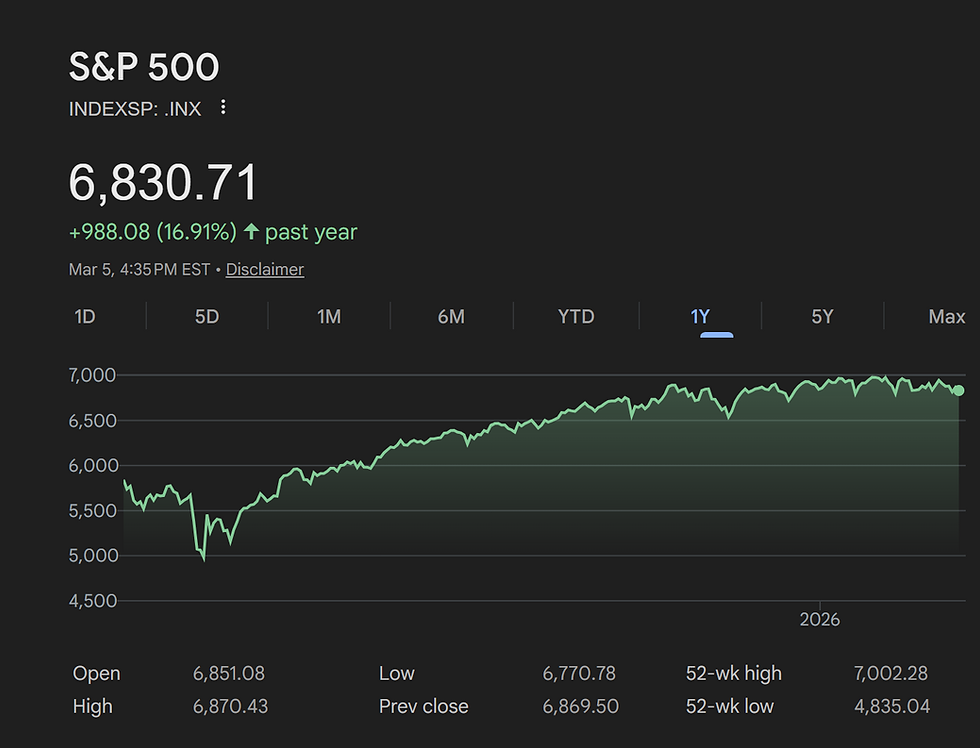
Index funds are a core port of my larger portfolio, and this has been great year for stocks. It was nice to see it outperform my alternatives (versus previous updates I published in earlier years). I also expect my real-estate and stock market investments to swap "first place status" many times over the coming years, since their long term raw returns are very similar. One thing I don't like about stocks right now is how the S&P is currently in a very unusual position. Instead of broad-based rallies, it's essentially a one-legged stool that's been propped up by a tiny # of companies: 7 AI firms.

And the historical record shows that periods of unusually narrow leadership — like the Nifty Fifty in the early 1970s or the late-1990s internet tech leaders — eventually saw crashes of around 50%. That doesn’t mean a crash is inevitable. But it does mean the market has become unusually dependent on much fewer drivers than normal (and that's not healthy). Still, I don't try to time the stock market, because studies show very few people can do it profitably over the long term. And even when a person is right on the direction...the market can remain irrational far longer than they can fight it. So I continue to invest in the stock market via dollar cost-average (and indexing). At the same time, I'm also not adding any discretionary money beyond that to the market (and am saving it for other areas).
S+P 500 bond index for large corporate grade bonds: 6.01%

Once again, my real-estate portfolio outperformed bonds. This wasn't too surprising as bonds have historically returned far lower over the long term):
Cybercurrencies: This was not a good year for bitcoin and it took a beating at -23%

I've long been a skeptic of the value of bitcoin as an actual currency and for many purposes (other than speculation). But there are plenty of other investors who have made lots of money from bitcoin. And there are many paths to financial success.
Commercial real-estate: the Greenstreet Real Estate "All Sector" CPPI index was up 2%. This index is composed of number of sectors including retail (20%), office (17.5%), apartment (15%), health care (15%), industrial (10%), lodging (7.5%), net lease (5%), self-storage (5%), manufactured home park (2.5%) and student housing (2.5%).

So it was good to see the real-estate recovery continue.
Core real estate: The NCREIF ODCE core real-estate index was up 4.9% on the year.

Again it was nice to see real-estate continue to recover.
Portfolio Allocation
Here's the low-level breakdown of my portfolio allocation.

As I mentioned above, I follow the core-satellite approach to managing risk. And so, the conservative core is made up of boring no-debt residential properties, which make up 50.9% of the portfolio (versus 61.2% last update). More on this below.
The rest is the satellite portion. And I allocated additional money to the following investments. (Note: added money isn't always easy to see from just the raw percentages. Since more money is being put into other areas as well, that can lower the percentage because it's a relative measure.)
Litigation finance (non-correlated asset): now 4.5% versus 3.2% last update
MG Properties (real-estate): now 19.1% versus 19.1% last update
Search funds (very small cash flowing business): now 4.4% (versus negligible last update)
GP Stakes (investments in fund managers): now 7% (versus 4.3% last update)
Private equity: now 5.3% (versus negligible last update)
I'll go into a deep-dive on each one of these in a minute.
My Portfolio: Real-estate Portfolio Allocation
But first, for all the real-estate buffs: here's how the portfolio is split out between real estate and non-real estate investments.

Real estate remained the largest portion of my alternatives portfolio at 70.9%. This is down from last update (which was 81.3%). Non-real estate is 29.1% and up from 18.7% last update.
How is that 70.9% of real estate allocation broken up? Here's what it looks like (with all of the types adding up to 100%):

Again, you can see my core-satellite approach, with the majority of it in very boring no-debt residential properties. (The "mixed" is from Front Street, which is mostly office, healthcare, mixed-use, and industrial development.)
Note that I deliberately haven't included my primary personal residence in any of these graphs and calculations. Technically, it is a real estate investment. And for many people, it's the largest investment they'll ever make (although this isn't the case for us). And my home also provides shelter, an additional value that's difficult to calculate. And more importantly, my family treats our home like more than an investment. We love it and spend money on it way above and beyond what would be done with a pure investment. So that's why I'm not including it here.
So going back to the graph... here's what's changed since my last update:
No-debt residential properties decreased a little to 71.8% now (versus 75.2% last update).
Multifamily increased a little to about 26.9% (versus 23.4% last update).
And for those who are curious, here's how my real-estate portfolio currently breaks out, by real estate investment:

Up next
In this first part I’ve focused on the overall structure and strategy of the portfolio.
In Part 2, I’ll go deeper into the individual investments that make up the portfolio — including real estate, GP stakes, litigation finance, music royalties, private equity, search funds and more — along with performance, income distributions, and lessons learned. And I'll discuss cash management, taxes and what I'm looking at going forward. Click here to view Part 2 (deal-by-deal returns and income).


