
A Reality Check on AI Predictions: Three Major Forecasts That Haven’t Held Up
By Ian Ippolito · Last updated October 1, 2026 · Code of Ethics
Months of programming with AI every day have made me a believer in its power—and increasingly skeptical of many of the predictions made about it. AI was supposed to have already wiped out massive numbers of jobs, made software free and ubiquitous, and made software developers extinct. But the jobs data is actually showing an AI boom. And as an investor, what's actually happening shapes my view of which investments will likely benefit from the emergence of AI (and which will be AI resistant).

(Usual disclaimer: I'm just an investor expressing my personal opinion and am not an attorney, accountant nor your financial advisor. Consult your own financial professionals before making any financial decisions. Code of Ethics: To remove conflicts of interest that are rife on other sites, I/we do not accept ANY money from outside sponsors or platforms for ANYTHING. This includes but is not limited to: no money for postings, nor reviews, nor advertising, nor affiliate leads etc.
Nor do I/we negotiate special terms for ourselves in the club above what we negotiate for the benefit of members. Info may contain errors so use at your own risk. See Code of Ethics for more info.)
In my three-part AI series this spring, I described how working with Claude Code turned me from a huge Artificial Intelligence (AI) skeptic into a believer that it will likely be transformative for people, business and society. So now it's fall and I've been working even more closely with AI (virtually every day) for months. And that experienced has amplified my belief that AI will become one of the most transformative technologies we humans have invented. But it's also shown me some of the glaring holes with AI. And it's also made me very skeptical about some of the claims and predictions that have been made. So this article is about how three major predictions have failed to hold up.
Prediction 1: Where's the Jobs Apocalypse?
A Scary Story that Shook the Markets
In February of this year, Citrini Research and Alap Shah published “THE 2028 GLOBAL INTELLIGENCE CRISIS,” shocked markets with a "thought experiment" (that we discussed in Part 2 ). It was written as a hypothetical account looking back from 2028 and how AI torpedoed the economy. And the Bloomberg-style headlines in it were imagined announcements from that scenario.
Per that scenario, serious layoffs would be well underway by now:
The initial wave of layoffs due to human obsolescence began in early 2026, and they did exactly what layoffs are supposed to. Margins expanded, earnings beat, stocks rallied. Record-setting corporate profits were funneled right back into AI compute.
....and companies cutting 15% of their workforce:
SERVICENOW NET NEW ACV GROWTH DECELERATES TO 14% FROM 23%; ANNOUNCES 15% WORKFORCE REDUCTION AND ‘STRUCTURAL EFFICIENCY PROGRAM’; SHARES FALL 18% Bloomberg, October 2026
....and AI was shown rampaging through the economy and causing massive economic damage:
For every new role AI created, though, it rendered dozens obsolete. The new roles paid a fraction of what the old ones did.
...and record un-employment:
U.S. JOLTS: JOB OPENINGS FALL BELOW 5.5M; UNEMPLOYED-TO-OPENINGS RATIO CLIMBS TO ~1.7, HIGHEST SINCE AUG 2020 Bloomberg, Oct 2026
So when the report hit, investors across the globe hit the panic button And per Bloomberg, in a report published by the Taipei Times on February 25, the paper contributed to a global software-stock selloff. Even the co-author Alap Shah was surprised, as he told Bloomberg Television:
I thought there was going to be a small reaction — it was definitely larger than we expected
To be fair, software stocks were already sliding. On February 5, Reuters reported seven straight days of losses and about $1 trillion erased since January 28. So the paper poured fuel on a fire that was already burning.
And by May 14, The Economist, like many sources, warned readers to “Prepare for an AI jobs apocalypse.”
Instead... a Hiring Spree?!
However, by the fall (September 4), the Economist had to take a step back and announced some surprising news. The title was: “The jobs apocalypse is postponed. An AI jobs boom is here”:
How could this be? Per The Economist:
On September 4th the Bureau of Labour Statistics reported that the American economy added 162,000 jobs in August, far above expectations. ... The unemployment rate is 4.1%, lower than in almost 90% of months over the past half-century. ... Add it all up, and The Economist estimates that AI has so far created around 1 million new jobs in America. That easily exceeds the roughly 200,000 lay-offs attributed to AI since mid-2023, and appears more than enough to offset weaker hiring in many back-office roles.
By that estimate, AI has created roughly five times as many jobs as the layoffs attributed to it. And those new jobs come from two main view places.
The first is building and running data centers, the warehouse-sized buildings full of computers that AI runs on:
Indeed, a jobs website, finds that data-centre vacancies have more than doubled in two years even as job postings overall have fallen. LinkedIn, a social network for strivers, estimates that nearly half a million data-centre jobs were created between 2023 and 2025 in America, with technicians and engineers among the most common recent hires.
The second is IT and AI-specific work... the exact sectors that some predicted would be hammered the worst by now:
It is not just hard hats that are proliferating. AI is also creating a new class of white-collar jobs. Engineers build the models, data annotators label their inputs and judge their answers, “forward-deployed” engineers adapt them for customers, and newly minted “heads of AI” decide what companies should do with the technology. Some of these roles barely existed until recently. Many are quickly growing in number. Postings for heads of AI, AI engineers and directors of AI have roughly doubled since 2023-24, according to LinkedIn.
In Part 1, we talked about how technology revolutions often create new classes of jobs that did not exist before. And we talked in detail about the emergence of those new roles, which fall under the generic umbrella of "AI builders".
Later in the article, The Economist said:
LinkedIn’s own analysis points to roughly 640,000 new AI-specific jobs between 2023 and 2025. “To date, the evidence suggests that AI has been a net job creator,” says Kory Kantenga, head of economics for the Americas at LinkedIn.
So this is the opposite of what quite a few pundits were predicting.
Even the AI CEOs Are Recalculating
OpenAI CEO Sam Altman admitted in May that the job losses have been slower than he expected. He told Reuters' Scott Murdoch:
I thought there would have been more impact on entry-level white-collar jobs being eliminated by now than has actually happened
Anthropic CEO Dario Amodei has also been adjusting his messaging and discussing a more hopeful outcome. You might remember that Amodei made one of the most alarming forecasts, which I quoted in Part 2. In May 2025, he told Axios that AI could "eliminate half of entry-level white-collar jobs and push unemployment to 10–20% within one to five years". More recently, at Anthropic’s May 5, 2026 event, Amodei talked about how AI might actually expand the work available for people to do. And Fortune reported: "Dario Amodei spent last year warning of an AI white-collar bloodbath. Now he’s changing the narrative". Per Amodei:
If you automate 90% of the job, then everyone does the 10% of the job.
That was a central point of Part 2 of this series: Technology that automates less than 100% of a job, has often left employment and jobs for people to do.
And as we also discussed Part 2 : in every human profession there are areas that go beyond even the theoretical future capabilities of AI -- and are effectively an AI "no-go" zone. And that's true in even the most AI-penetrable industries (like computers programming and office administration).
See green highlighted areas below:
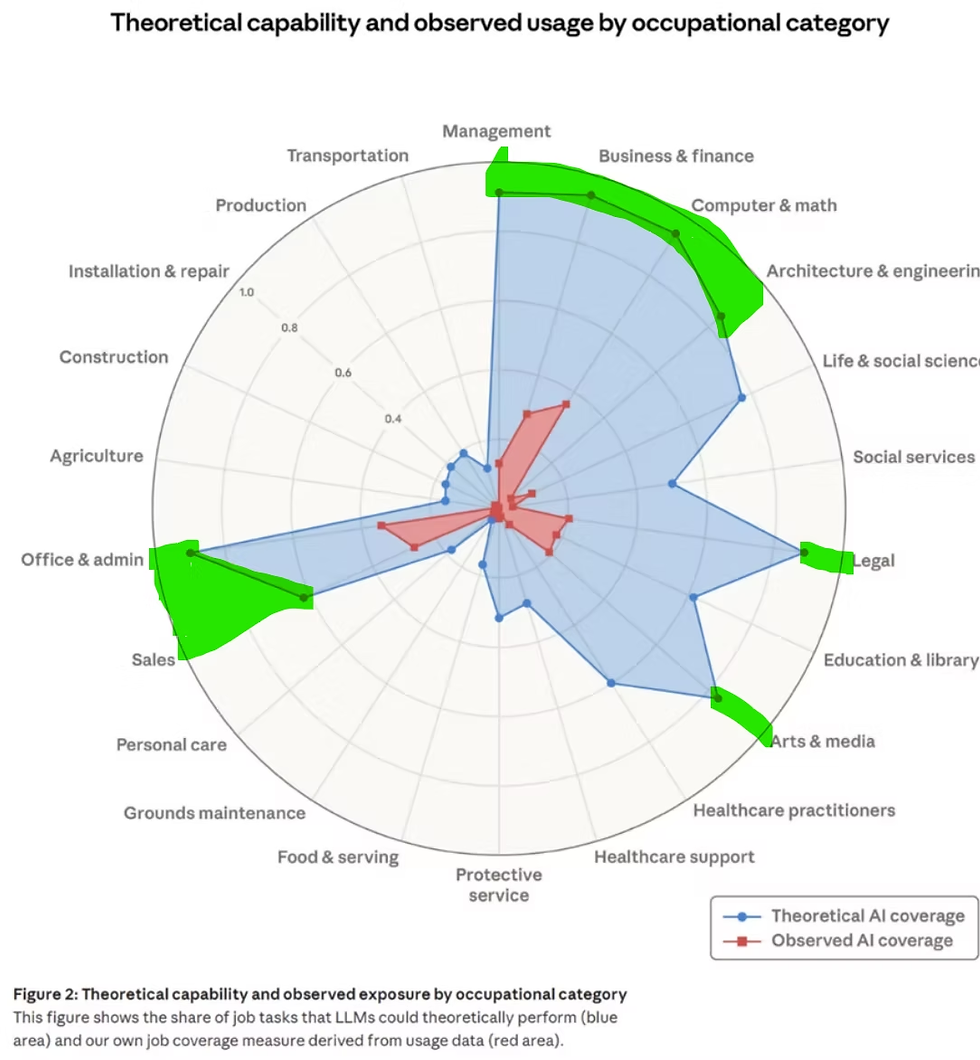
Meanwhile in the Forbes interview, Amodei went on to describe the remaining human work expanding as people become more productive. The full exchange is in the interview transcript, starting at 33:27.
Why Someone Still Has to Be There
Part of the reason a human can't be automated out of the loop is that AI's results are inconsistent. As Jessica Zhang of payroll and HR company ADP told CNBC's Justina Lee in July:
“Where AI outputs are inconsistent, inaccurate, or difficult to apply, companies ...need to reintroduce human oversight,”
And the important point here is that these problems are not just a temporary glitch with the current AI models. As we'll discuss further below, many are fundamental limitations that's actually baked into the underlying architecture of how all large language models work.
Oops! Bosses Do an About-Face
Notably some employers who cut jobs because of AI are now hiring people back.
Workforce-planning firm Orgvue's Spring 2025 report found that a majority of leaders who made AI-related cuts admit mistakes:
Two in five (39%) say they’ve made employees redundant as a direct result of AI. And of those, more than half (55%) admit they made the wrong decision about those redundancies.
And the jobs are already coming back. Robert Half reports that 32% of U.S. hiring managers who eliminated positions after implementing AI later brought those or similar roles back.
Research firm Gartner expects more reversals. Jan Bansch and Joe Coyle wrote in June:
Gartner predicts that up to 30% of roles displaced by AI will be rehired by 2029 — often at a higher cost.
Gartner also forecasts that half of the companies that cut customer-service staff because of AI will rehire people for similar work by 2027.
And some big companies have already reversed course. The BBC's Liv McMahon reported in June that Ford rehired more than 300 veteran quality inspectors after its automated systems fell short. Charles Poon, Ford's vice president of vehicle hardware engineering, explained the mistake:
"Mistakenly, we thought that by just introducing artificial intelligence and ingesting the design requirements that we had, that would produce a high-quality product"
Then there's Klarna. The payments company had claimed its chatbot did the work of 700 human agents. Fortune's Irina Ivanova recounts CEO Sebastian Siemiatkowski's position in early 2025:
“I am of the opinion that AI can already do all of the jobs that we, as humans, do,” the CEO told Bloomberg in February.
By May 2025, he sounded quite different:
“As cost unfortunately seems to have been a too predominant evaluation factor when organizing this, what you end up having is lower quality,” he told Bloomberg this week. “Really investing in the quality of the human support is the way of the future for us.”
And Klarna began recruiting human customer-service agents, so customers could reach a person again.
Prediction 2: Software, Software Everywhere... But Is It Usable?
"Software will be free and ubiquitous" view
Sultan Meghji runs an AI company and previously served as chief innovation officer at the FDIC, the federal agency that insures bank deposits. In February of this year, he wrote:
We are entering an era where the barrier to software development is functionally nonexistent. ... The question isn’t whether software will be free. It already functionally is.
And he wasn't the only one. Many people echoed similar ideas including David Shapiro :
Open source AI will be democratized, and ... software will be free and infinite.
But what has happened in practice is that AI coding hasn't removed major parts of the major parts of the work of making software useful and dependable.
Software still has plenty of binding constraints
“In software, the binding constraint appears to be shifting from writing code to reviewing, integrating, and ultimately distributing it,”
In plain English, the hard part remains checking the code, making it work with everything else and getting it to people. And when AI can crank out the low level code faster than before, a company can actually need more people to do this work than before rather than less. This is related to Jevons paradox, which we discussed in the previous articles. The concept comes from economist William Stanley Jevons, who observed in 1865 that more efficient steam engines didn't decrease coal consumption like everyone thought they would. Instead the opposite happened. Coal consumption soared because steam power was suddenly economical for so many more uses. And AI appears to be causing similar effects.
A Flood of New Apps that Nobody Wants
Then there's also the AI-slop problem. Across four major app stores and software marketplaces, researchers' September update found a 4x increase in new apps—but no increase in total human usage. So filling the stores with tons of AI-generated software hasn't given people more useful software.
What went wrong?
So why has AI been unable to penetrate certain areas of work like many predicted? The main issue is that large language models—the technology behind tools like ChatGPT and Claude—have some built-in limitations that are inherent to the things that actually make them work.
Limitation 1: It Needs Mountains of Examples
As I explained in Part 2 of this series, these models learn by training on enormous collections of human-created material. So the availability of relevant examples matters.
That works well for common things like screen layouts, buttons and forms, which have vast numbers of public examples. But every company's custom business software has its own private rules and exceptions. How does this particular process work? Who is allowed to do it? What happens when there are problems? How should unusual exceptions be handled? Which exceptions apply? etc.
General training data can't supply rules the AI has never been given. So a human has to explain those requirements and check that the software follows them. That is becoming the role of "AI builder".
Limitation 2: A Genius Hire With a Goldfish's Memory
Memory is another weak spot. The Information's Rocket Drew explains how today's AI memory works:
When ChatGPT learns more about you over time, it's leaving little notes to itself that it can reference at a later date.
And he compares it to hiring an intern:
It's not like the way humans pick up new knowledge on the fly and from experience. It's like you hired an intern and the intern works for a day, and by the end of the day, it's a little bit better at its job. But then it leaves a note to itself, and it wakes up the next day with amnesia like Groundhog Day, and comes into the office and reads the notes that someone else left for it and tries to remember how to work. It doesn't really feel like the true solution to learning on the fly and flexibly incorporating new skills.
This is a major limitation of AI. And it can be a considerable source of frustration to people who are new to using it -- when they don't understand why it is forgetting things that they just told it to do.
Limitation 3: Non-determinism: Ask the same question three times and get three different answers.
A calculator gives the same answer every time you repeat a calculation. And so does a traditional computer. But with AI, repeating the same request often gives you a different result. And the more complex the question, the higher the chance of a different answer. This because, despite the name "artificial intelligence", a large language model does not actually have the ability to reason. All it does is taking whatever you typed, going through its memory of similar words, and seeing what words were usually said in response by others in its data set. That's it. It's basically using probabilities to figure out what English words are usually said in response to whatever you typed. And this is very different than what humans usually think of as intelligence. And often results in different answers.
Context changes. After you ask the question the first time, the AI's context stores the answer and your response to it. And it uses that when running its probabilities for the second time. So this alone often causes a different answer.
Different conversation. If you ask the question the first time in a certain conversation, that also developed context around it. When you ask it the second time in a second conversation, the probabilities are going to be different. So this is another reason you can get a different answer.
Other AI users. Even if you ask the exact same question using the exact same context and the exact same conversation, you can still get a different answer. That's because other users of the AI who you cannot even see or know about, can affect the answer you get. Thinking Machines Lab in "Defeating Nondeterminism in LLM Inference" said :
Reproducibility is a bedrock of scientific progress. However, it’s remarkably difficult to get reproducible results out of large language models. ... As it turns out, our request’s output does depend on the parallel user requests.
In other words, when multiple users are querying AI in parallel, it can change the results.
And this non-determinism makes the AI memory problem we talked about earlier, worse. To continue with that analogy: when the intern's memory gets erased and it has to to make do with the notes of what happened, it will often read them inconsistently, too. GitHub's own documentation warns:
Copilot may not always follow your custom instructions in exactly the same way every time they are used.
And a human who worked like this would be fired. An employee who keeps forgetting instructions, or applies them differently from one day to the next, isn't dependable enough to leave unsupervised. So human checking and correction remain necessary with AI.
Prediction 3: Software Developers Would Become Redundant
The prediction was that software developers would become redundant.
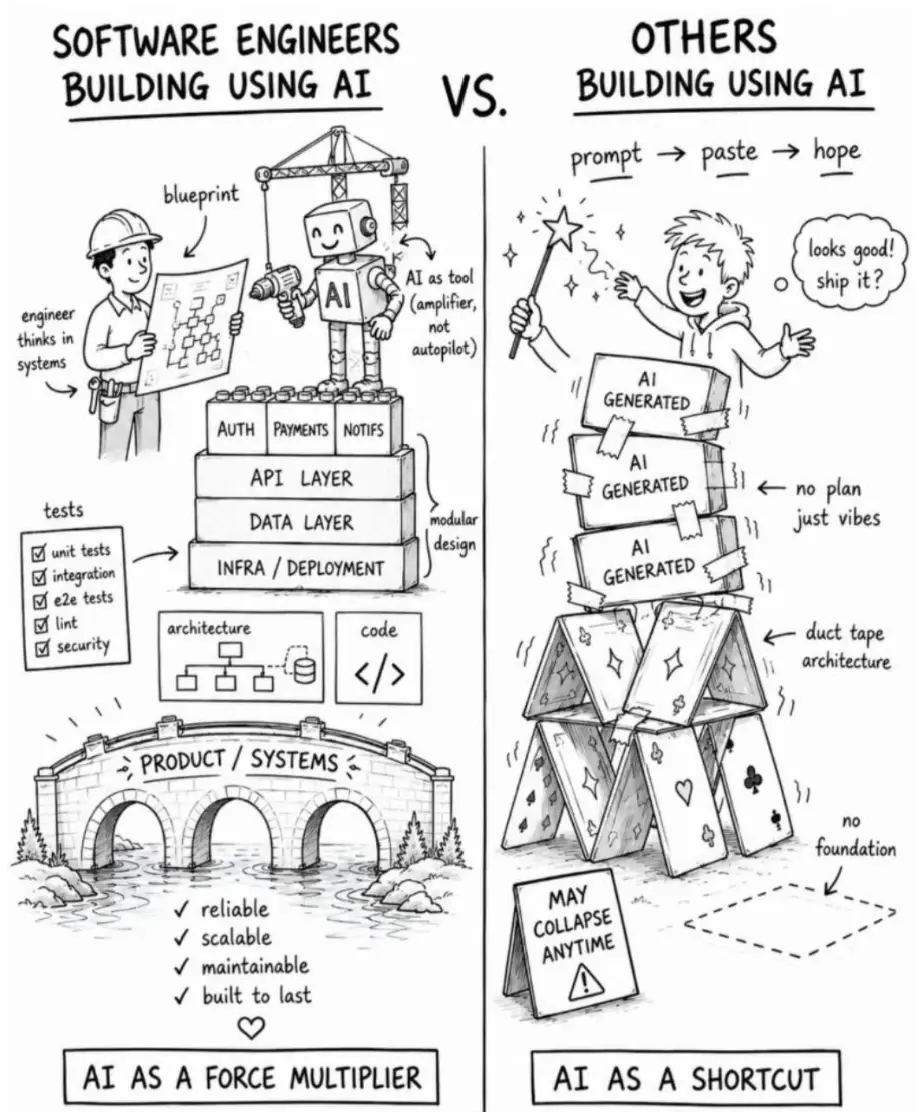
However in practice, AI generating code still leaves people with plenty of work: deciding what to build, directing the AI and checking whether the result actually works. That's the builder's job--which I talked about In Part 1. AI builders use their domain knowledge and creativity to solve business problems with AI tools. And that's also the new profession that The Economist described earlier, as being created by AI.
When Vibe Coding Goes Wrong
"Vibe coding" means asking AI to build software and accepting what comes back without understanding or checking it. And the results can be ugly:
Moltbook: Security firm Wiz's investigation found exposed private messages and 35,000 email addresses, and researchers could even alter posts. The founder said he wrote none of the code. view
METR: This AI research group's incident report describes failed login protection in a vibe-coded application. An attacker consumed approximately $600,000 worth of donated AI credits.
When nobody checks what the AI built, the damage can be enormous. To make systems usable and reliable, requires a lot of human oversight and effort:
"AI Vampires"
One interesting thing I've noticed when working with AI, is that it is highly addictive. It is very easy to just say "I'll just fix this last problem before bed" and end up working until 3 AM in the morning before realizing what happened. And so many software developers are working into the wee hours that there's become a name for them: “AI Vampires.” Developer Steve Yegge says:
Agentic software building is genuinely addictive. The better you get at it, the more you want to use it.
Yegge also describes suddenly falling asleep after long sessions. So the same tools that lets people accomplish more can also make it hard to stop. Megan Morrone's Axios report gives another example:
Quentin Rousseau, CTO and co-founder of the incident management platform Rootly, told Axios he couldn't sleep for months after switching to agentic coding. Eventually he needed a doctor to prescribe sleep medication just to shut his brain off at night.
Why is this?
It's the intermittent reward. Many times, you'll get something acceptable. And sometimes you'll get garbage. But sometimes you'll get something incredible that is 50x better and faster than you could have done your own self. And humans find this extremely addicting.
Consumer-psychology researcher Max Alberhasky explains the pull in Psychology Today:
When rewards are given sporadically for the same behavior, we are particularly intrigued to keep working for a reward.
The casinos in Vegas have known this for a long time. And their slot machines keep people playing by paying out occasionally and unpredictably.
And with AI, the next prompt becomes another pull of the lever.
Software engineer Roger Goldfinger describes the addictive experience in “Claude Code is a Slot Machine”:
Part of why AI coding tools are so popular is the slot machine effect. Intermittent rewards.
So many developers are finding themselves having to learn new skills to keep their AI usage in check and prevent themselves from working all night long and becoming AI vampires.
Next article (Part 5): Why AI is unexpectedly expensive and how all of this affects my investing strategy
So plenty of predictions about AI have failed to pan out. And what's actually happening on the ground with AI shapes how I invest. AI needs people to design the systems, supervise the work and catch the mistakes. That makes me more interested in businesses built around that. AI also takes a lot of money and electricity to run, which points to the buildings, networks and power behind it. In the next article, I go through this in more detail as well as the various investments I've found in each area, what has and hasn't passed muster, and where I'm still looking.
Click here for Part 5
-------------------------------------------------------------------------
Discussing AI and More
Private Investor Club members have been discussing AI in depth. There’s also been detailed discussion on thousands of sponsors and deals (including due diligence and real-life investor experiences).
If you're already a member, click here to discuss further:
If you're not yet a member, then joining is free.
- To protect all members and keep the conversations useful and confidential, all applicants are required to verify that they're solely investors (and not investment sponsors, platforms or their affiliates).


