
Navigating the Future: AI's Impact on Investments
Updated: Jun 2
By Ian Ippolito · Last updated May 26, 2026 · Code of Ethics
If AI fulfills its promise, the economic effects will be profound. This article considers various investment ideas for navigating a theoretical world in which AI succeeds in delivering.
(Usual disclaimer: I'm just an investor expressing my personal opinion and am not an attorney, accountant nor your financial advisor. Consult your own financial professionals before making any financial decisions. Code of Ethics: To remove conflicts of interest that are rife on other sites, I/we do not accept ANY money from outside sponsors or platforms for ANYTHING. This includes but is not limited to: no money for postings, nor reviews, nor advertising, nor affiliate leads etc. Nor do I/we negotiate special terms for ourselves in the club above what we negotiate for the benefit of members. Info may contain errors so use at your own risk. See Code of Ethics for more info.)
In Part 1, I explained why Claude Code changed me from an AI skeptic to a believer. I discussed the effect of AI's improvements on computer programming and the AI-enabled builder.
In Part 2, we talked about how coding accelerates AI progress. We made the cases for both rapid change and AI stalling or stopping. We also considered: If AI succeeds, what profound scientific advances and economic revolution is likely to come? What effect will this have on jobs and humanity?
In this article, we assume AI does realize its potential. We ask the question: "How should an investor position themselves for an economy that's driven by AI?"
Investing to Catch the AI Wave
There are many investments that could benefit from AI achieving its goals.
1. AI Itself
AI Models:
- Public Stocks: The "Magnificent Seven." (Examples: Apple, Microsoft, Alphabet, Amazon, Nvidia, Meta Platforms, Tesla).
- Privately Held: If AI models succeed, there could be significant upside when these go public. Examples include Anthropic and OpenAI. (Example: InvestX AI and robotics fund has private holdings in both of these).
AI Infrastructure: This includes AI chips and data centers. (Example: Accordant data center fund).
AI Venture Capital and Private Equity: Stakes in AI and AI ecosystem startups. (Examples: Quartus AI fund, InvestX AI and robotics fund).
2. Energy and Infrastructure
As we discussed in Part 2, if AI keeps growing, the real bottleneck is quickly becoming power and infrastructure.
These could quietly become one of the most important parts of the AI story. They would be a "pick-axes" play (similar to how selling pick-axes and supplies was a great way of making money during the California Gold Rush).
Oil and Natural Gas Infrastructure: (Examples: Mewbourne Oil Company, Waveland Energy Partners Fund VIII).
Nuclear / Small Modular Reactors.
Grid Upgrades.
Transformer Manufacturing.
3. AI-Enabled Builders
"Builders" are a brand-new profession where people use AI tools along with their human creativity and domain knowledge to solve business problems. As we discussed in Part 1, they are already springing up in some companies.
As companies engage in their never-ending journey to stay competitive, be more efficient, and move into new markets, their needs grow as well. This new sector is poised to fulfill a lot of pent-up demand.
Some examples include:
Custom Software Creation (discussed in Part 1).
Workflow Improvement and Automation (including implementing AI agents). Example: Perplexity's Computer product and similar companies.
Cybersecurity (AI models such as OpenClaw and others are already increasing attack risk).
There are also specific niches where companies have large needs that match up to the capabilities of AI-enabled Builders:
Product Design and Customer Experience (including rapid prototyping of full applications and personalized user experiences).
Sales, Marketing & Growth (including market analysis, customer segmentation & targeting).
Legal and Compliance (including contract analysis, litigation prep, and discovery).
Financial Modeling & Forecasting.
Healthcare & Medical Operations.
Education and Training.
4. AI Labor-Scarce / Physical Sectors
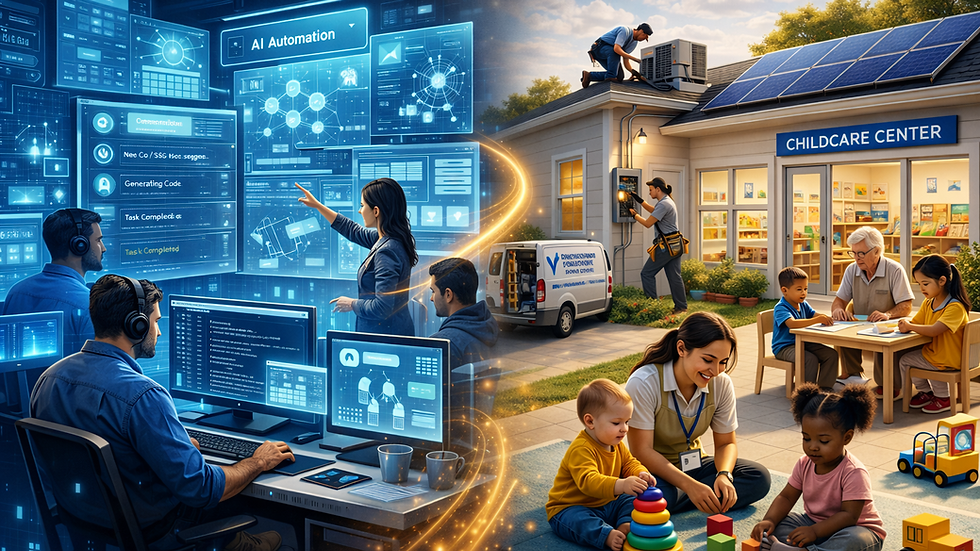
If white-collar roles get squeezed, money and talent could shift toward areas outside AI's reach. These include hands-on physical work (at least until robots potentially arrive sometime in the future). The following areas, which I explore further later in this article, are AI "no-go" industries (shown in white on the Anthropic chart):
Direct:
- Local Businesses:
- Skilled Trades: Examples include Installation and Repair, Construction, Electricians, HVAC Contractors, Plumbers, Cabinet Makers, Auto Repair Shops, etc.
- Infrastructure Maintenance: Transportation, Production, Agriculture, Grounds Maintenance, Landscapers, etc. (Example: Proterra Net Lease for mission-critical food chain).
- Health Services: Personal care, Healthcare support, Childcare, etc. (Example: Outpatient Medical Buildings).
- Examples: Search Funds are micro-private equity funds that buy small, local businesses like these. They include: Relay Investments, Vonzeo Capital, Nextgen Partners, and Ambit Partner.
Indirect: These are also "pick and axes" plays that make money by supplying these industries:
- Shallow Bay / Small Bay Industrial Real Estate:
- This is a niche that several industrial sponsors are pivoting to, as the economics and growth are very attractive compared to standard industrial (which itself has been very attractive).
- This is different from "big box" industrial that many people think of for the asset class (which rents to a single company and is in a separate, industrial-only part of the city where no one else lives).
- Small bay industrial is renting to small tenants that need storage close to their local service territories (so in the middle of where people live) for tools, trucks, and materials.
- These are people like electricians, HVAC contractors, plumbers, landscapers, auto repair shops, small manufacturers, cabinet makers, flooring installers, local distributors, etc.
- Example: Denholtz Properties Shallow Bay Industrial Fund.
5. Education & Retraining
When technology reshapes jobs, people need new skills. That will create high demand for training.
Vocational Training Platforms.
Trade Schools.
Certification Programs.
Apprenticeship Models.
6. Legal / Compliance / Governance
Every big technology shift creates new rules and oversight. AI likely won’t be different:
RegTech (Regulatory Technology).
Compliance Service Providers.
Audit Infrastructure.
AI Liability Insurance (could see enormous growth).
7. Human-Centric Premium Brands
Sometimes tech growth increases demand for things that feel "human." If AI makes things more automated and generic, people could end up valuing the "human touch" more.
Luxury Goods.
High-Touch Services.
Experiences.
Sports and Entertainment. (Example: AlphaSummit).
Pets.
8. Dislocated White-Collar Asset Plays
For those with an appetite for higher risk/reward, periods of change usually create both winners and stressed sellers. If certain sectors struggle, there may be opportunities for:
Buyouts of Businesses Slow to Adopt AI.
Consolidation in Service Sectors.
This article series is a work in progress where I'm documenting my thoughts as things develop. So I welcome your feedback.
Please add your comments and suggestions in the Private Investor Club forum discussion on AI investing. (If you're not a member, you can join for free and just have to confirm you have no business connection with any sponsors or their affiliates).
Next, let's dive into one that looks interesting: AI labor-scarce / physical sectors. We’ll look closer at potential pros and cons.
Rise of the "AI-Resistant Investment"
The last major technology revolution was the internet. It created Amazon and caused the "retail apocalypse."
Seemingly overnight, retail stores that had been around for decades (including Sears, Toys R Us, and others) were wiped out and declaring bankruptcy one after another.
At first, there was a huge panic and flight from all retail real estate because many people thought it would completely disappear.
But very quickly, people realized they overreacted—not all retail could be "Amazoned."
By 2017-2019, the big focus in retail was on ensuring everything was "Amazon resistant." This included groceries, pharmacies, fitness centers, restaurants, nail salons, medical/dental clinics, and more.
Ultimately, that strategy ended up working very well for many investors:

So I thought... that early panic sounds similar to what I'm hearing from some people right now.
What would an "AI-resistant" investment fund look like?
There are many ways to approach this.
One idea is targeting any of the AI no-go zones (which are beyond even the theoretical capabilities of AI).
I've highlighted this area in green (with interior in white) below:

There's a lot of fertile ground there.
Here's one example of that kind of thinking: targeting skilled trades, healthcare services, education, and hands-on service jobs that are among the least vulnerable to AI automation:
Home Services
Plumbing
HVAC
Roofing
Electrical
Landscaping
Construction
Property Maintenance
Fire Safety Inspections
Elevator Maintenance
Pest Control
Parking Lot Maintenance
Local Service Providers
Childcare Centers
Assisted Living
Physical Therapy
Veterinary Clinics
Spa/Beauty/Hair Salons
Industrial Services
Equipment Repair
Specialty Manufacturing
Waste Handling
Why These Work:
Local monopolies.
Skilled labor shortages.
Hard to automate.
Hard to scale nationally.
These are often called “small boring businesses that print money.”
Counter-Arguments and Thoughts
Here are some counterarguments to that idea (along with my thoughts on those):
1) Flood of Workers
One counterargument is that while today these are lucrative niches, they might not stay that way. One of the potential AI scenarios is that of wide-spread white-collar job loss. If that happens, there could be a rush of white-collar workers into these jobs.
That seems plausible.
At the same time, a rush of all workers into these jobs is also not guaranteed. If AI succeeds, a rise in new jobs like builders and others could slow this down, leading to much less extreme scenarios than Cintrini research envisioned in their "thought experiment" / "potential scenario." But let's say it does happen.
If it does, it would definitely be bad for the workers because it would reduce wages.
However, that's not necessarily the same thing for a company owner.
In many past technological revolutions, automation moved income from labor (workers) to capital (owners).
From an owner's point of view, wages are a major cost—reductions have a positive effect. What matters most for an owner is profit margin (revenue - cost). So in this scenario, profitability wouldn't necessarily go down.
Still, if someone is concerned about wage drops affecting investment, there are ways to address this.
A uniform flood into all industries is very unlikely. Many people could become Uber drivers quickly and easily. Fewer would take the four years to apprentice as an electrician and pay for an expensive license.
So an investor could focus on industries with larger barriers to entry or which require lengthy apprenticeships (or time-consuming/expensive licenses).
2) Robots
Another counterargument to the thesis is that robots will soon be everywhere, ultimately taking over all the areas where AI can't currently go.
I personally agree with the concept and feel it's likely to happen in the long run.
But again, while this could be bad for employees working in those fields, it's not necessarily negative for the company owners, and, by extension, for investors.
Again, in many past tech revolutions, automation moved income from labor (workers) to capital (owners).
Radical changes usually invent radical new business models. It's not hard to imagine that owners could make a good profit by owning robots that do the physical labor for them. There could also be bigger companies (and private equity funds) purchasing these small businesses, since they're now much more scalable. That might lead to a profitable exit as well.
On top of that, many experts say the timing for worrying about robots (in regards to taking over jobs completely) is likely to be much further out than the robotics companies are making it seem to the general public.
They say that quite a few robotics companies have been guilty of performing deceptive tricks to make robotics look much further along than they actually are:
Humanoid robots are riding a wave of hype... However, most humanoid robots have not yet been deployed in real-world environments.
Many humanoid robot demos are staged in tightly controlled settings, and some use teleoperation, where human operators pilot the robots remotely.
Loosararian called teleoperation the "dirty little secret" of robotics, adding that robotics companies had a responsibility to inform customers about whether their humanoid robots are operating ... with human assistance.
In the short- to medium-term, many experts feel there are enormous challenges with that kind of ubiquitous robot use (much more difficult than what AI faces).
This paper from Cognative explains the huge disconnect between the hype and public perception versus the actual state of the robotics technology:
Humanoid robots are technologically impressive but commercially premature.
After years of promises and countless investor presentations showcasing sleek, agile humanoids, the industry faces a harder truth: ambition has outpaced practical readiness.
Critical gaps remain in dexterity, energy efficiency, and real-world applications. Regulatory, ethical, and infrastructural readiness still lags behind technical prototypes.
As Rodney Brooks—one of the most respected figures in robotics—cautioned, “The world is just not quite ready for humanoids yet.”
This statement is less about skepticism and more about engineering and commercial reality catching up to vision.
For example, it's currently very difficult to create a moving, humanoid robot that does not accidentally injure or kill people nearby. This is why most robots in real-world use are kept in an area separated far away from humans.
Per the 2025 research paper from the Lincoln Centre for Autonomous Systems called "Human-robot interaction in unstructured settings":
Robots working near or alongside people in a shared space need behavior that humans can interpret, anticipate, and coordinate with. Safety remains difficult. Real-world deployments inevitably encounter situations in which these capabilities prove insufficient.
There are even more challenges to the making of a multi-purpose robot that can do the hundreds or thousands of tasks required of a job (which humans do very easily without thinking about them):
Per a January 2026 Business Insider article, even a single-task robot is very challenging:
Daniela Rus, the director of MIT's Computer Science and Artificial Intelligence Laboratory, said there was a gap between robots' ability to perform tasks in a laboratory and their ability to take on jobs traditionally done by humans in the real world.
"I can give you a robot that will fold your laundry and load your dishwasher, but it might cost you half a billion dollars," she said.
So there's lots of work left to do before robots are rolled out broadly into human-facing industries and interactions. Most feel that robots are more likely to comprise a much later wave (hopefully powered by the AI wave)... rather than joining this upcoming one.
However, if a person is concerned about robots causing lower profits, they could also concentrate on investments that are both AI- and robot-resistant (like many in the earlier list that depend on the human touch and/or the reassurance of a human's reputation and malpractice insurance, etc.).
3) General
This idea is a work in progress, and your input on this idea is welcomed. You can discuss it (and other AI-resistant investments) further in the Private Investor Club forum discussion on AI investing. (If you're not a member, you can join for free and just have to confirm you have no business connection with any sponsors or their affiliates).
What’s Up Next
I am in the middle of a deep dive on AI (this is only the beginning). I’ll share what I learn via more articles.
The next article will probably focus on the revolutionary new development of desktop AI agents. These systems move beyond using AI in a chat in the cloud and instead operate directly on your computer to perform real tasks (making AI much more usable).
One example is OpenClaw, an open-source project created by an independent developer. In just three weeks, it became the most downloaded open-source project in history. This is a record that took the former champion (Linux) three decades to achieve.
As Jensen Huang (founder and CEO of NVIDIA) said a few days ago:
Mac and Windows are the operating systems for the personal computer. OpenClaw is the operating system for personal AI. This is ... the beginning of a new renaissance in software.
So there are lots of interesting and exciting developments to explore.
[Updated March 28, 2026] This is changing overnight at breathtaking speed. A few weeks ago, Open AI hired the creator of OpenClaw. A few days ago, Anthropic already pushed out OpenClaw features into Claude Code (such as scheduling, automated runs, etc.). Presumably, more will be coming soon, and we'll talk about it.
Conclusion
For the past several years, I’ve been skeptical of the AI hype.
A lot of that skepticism is still justified. The industry has spent extraordinary amounts of money, most companies have seen very little real-world value from the product, and a lot of the hype has been over-the-top.
But my experience with Claude Code changed my perspective.
For the first time, I saw a clear example of AI performing complex professional work at a level that would have seemed entirely impossible only a few months ago. And it did so far faster, cheaper, and better than any human developer could have managed.
If AI fails to overcome its many challenges, it may still end up following the path of many past overhyped technologies, being delayed for a long time (or completely fall off the tracks).
Either way: what it's already accomplished will have a lasting effect on the economy and jobs.
If it succeeds, then the effect on both our economy and society will be enormous.
If exponential growth is sustainable, then—similar to what we saw with genome sequencing, computing power, and the internet—the future will be here sooner than most expect.
-----------------
Discussing AI and More
Private Investor Club members have been discussing AI in depth. There’s also been detailed discussion on thousands of sponsors and deals (including due diligence and real-life investor experiences).
If you're already a member, click here to discuss further:
If you're not yet a member, then joining is free.
- To protect all members and keep the conversations useful and confidential, all applicants are required to verify that they're solely investors (and not investment sponsors, platforms or their affiliates).


